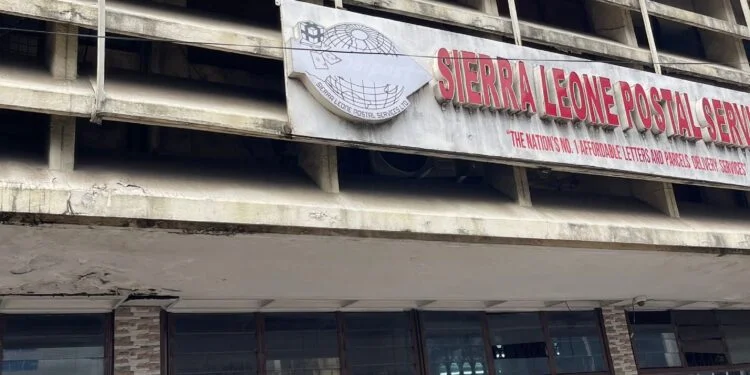
When was the last time you sent a parcel or important document through the Sierra Leone Post Office — Salpost?
For many Sierra Leoneans, it may be difficult to remember.
Yet the postal and delivery business itself is far from dead. DHL is still doing business in Sierra Leone, while Aramex, which came much later, is also operating. Restaurants use delivery riders, businesses move goods every day, and online shopping is growing.
So, if the business is alive, why is Salpost almost dead?
For me, management is perhaps the biggest problem behind Salpost’s downfall, as has been the case with several government parastatals over the years, including Sierratel. Lack of money may be part of the problem, but injecting money into an institution without proper management, accountability and a commercial strategy will not save it.
Salpost can be revived, but we must stop thinking of it simply as a place for letters and stamps and start seeing it as a national logistics and delivery company.
*Salpost Already Has the Infrastructure*
One of Salpost’s greatest advantages is that it already has offices and infrastructure across Sierra Leone.
These offices could become modern delivery and collection centres connecting Freetown with Bo, Kenema, Makeni, Kono, Kabala and other parts of the country.
Salpost could operate motorbikes for local deliveries, vans for parcels and even trucks for cargo between districts. Customers should be able to send goods anywhere in the country and receive a tracking number, SMS or WhatsApp updates and confirmation when the package is delivered.
That infrastructure should be an asset, not a liability.
*Online Shopping Is a Major Opportunity*
Sierra Leoneans are increasingly buying goods online.
Aramex has promoted arrangements allowing customers in Sierra Leone to shop from international retailers such as SHEIN and have their goods delivered to Sierra Leone at more affordable shipping rates.
Why couldn’t Salpost pursue similar partnerships?
Salpost could explore agreements with international e-commerce giants and marketplaces such as Alibaba, Temu or eBay, making it easier and potentially cheaper for Sierra Leoneans to buy goods online and receive them locally.
Salpost offices across the country could even become collection points for online purchases.
Instead of watching private companies capture this growing market, Salpost should be positioning itself at the centre of Sierra Leone’s e-commerce economy.
*Government and Businesses Could Become Major Customers*
Government can also play an important role.
Ministries, departments and agencies send documents and packages every day. Government could establish a policy for appropriate official deliveries to be handled by Salpost, provided Salpost meets strict standards for reliability, security and accountability.
Salpost should also aggressively pursue the private sector.
Mining companies, banks, telecommunications companies, NGOs and other established businesses constantly move documents, supplies and equipment around Sierra Leone. Why shouldn’t Salpost compete for those contracts?
It could sign agreements to manage some of their domestic courier, cargo and delivery needs, creating sustainable revenue instead of depending mainly on government support.
*Why Must We Go to Immigration Just to Renew a Passport?*
Salpost could also become an important part of delivering government services.
Why should someone have to make repeated trips to Immigration simply to renew a passport?
We should be working towards a system where eligible passport renewals can be initiated online. With proper security arrangements and an agreement with Immigration, a citizen could pay Salpost a fee to securely collect the required passport or documents and return the renewed passport.
The same concept could eventually be applied to other appropriate government documents.
Government services should increasingly move towards citizens rather than always forcing citizens to travel to government offices.
*From Groceries to Small-Business Deliveries*
Salpost could also enter the everyday delivery business.
Restaurants, supermarkets and shops already need riders. Salpost could provide trained delivery personnel so businesses do not always have to maintain their own motorbikes and riders.
Imagine ordering groceries from a supermarket and selecting “Deliver with Salpost.”
The same service could support the thousands of Sierra Leoneans selling clothes, food, electronics and other products through WhatsApp, Facebook, Instagram and other online platforms.
A seller in Freetown should be able to send goods easily to a customer in Kenema, Bo, Makeni or elsewhere through Salpost.
*Give Salpost a Modern Digital Platform*
None of this will work with an outdated system.
Salpost needs an effective website and eventually a mobile application where customers can request pickups, calculate delivery costs, pay for services, track parcels, locate Salpost offices and receive delivery updates.
If we can track a package coming from another continent, we should certainly be able to track one travelling from Freetown to Bo.
*Consider a Public-Private Partnership*
Government should also consider whether a properly structured public-private partnership could help transform Salpost.
A credible private partner could bring investment, technology, logistics expertise and commercial management while government maintains an appropriate interest in the institution.
But any partnership must be transparent and focused on performance.
Most importantly, management reform must come first.
We can buy trucks and motorbikes, renovate buildings and develop websites, but without competent management, accountability and measurable targets, Salpost will eventually return to the same problems.
*Salpost Can Live Again*
We should stop thinking about Salpost simply in terms of letters and stamps.
Think online shopping and e-commerce.
Think Alibaba, Temu and eBay.
Think passport and government-document delivery.
Think restaurants and grocery deliveries.
Think mining companies and corporate contracts.
Think motorbikes, vans and cargo trucks.
Think nationwide delivery and jobs for young Sierra Leoneans.
Salpost already has a recognised name, infrastructure and offices across the country. The delivery market clearly exists — DHL is in business and Aramex is in business while Salpost is almost dead.
That tells us that the problem is not the death of the postal business. The problem is how we have managed and positioned our own postal service.
Yes, Salpost can be revived. But it will require proper management, investment, technology, accountability, partnerships and a completely new business model.
We don’t need to bury Salpost. We need to transform it into a modern national logistics and delivery company.